A cross-BHP team from the Royal Orthopaedic Hospital NHS Foundation Trust (ROH) and Aston University has won a place on the SPARK The Midlands programme to help further the development of its minimally-invasive, anti-cancer and bone regenerative injectable paste, which uses the cancer-killing properties of gallium.
SPARK The Midlands provides specialist technical and academic support to advance healthcare research discoveries in the region from the bench to bedside.
The team will use the SPARK programme to secure a clear pathway for the cancer-killing paste to be adopted in clinics and hospitals. If proved effective through clinical trials, the paste – a gallium-doped bioglass – could be used to treat patients with primary and metastatic bone cancer.
Dr Lucas Souza, Research Laboratory Manager at the ROH, said: “Where the global success rate for new ideas making it to clinical trials is less than 5%, SPARK has recorded a project success rate of 62%. Thanks to this programme, the ROH will have the support to develop a regional pipeline for the translation of ideas for orthopaedic and bone cancer applications to NHS-approved medical use.”
World class cancer care needs world class cancer research, so support programmes like SPARK are essential in steering NHS-led research through clinical trials and into patient care.
SPARK is a collaboration between Aston University, the West Midlands Health Tech Innovation Accelerator (WMHTIA) and Forging Ahead. The programme originated at Stanford University in California and has proved hugely impactful in improving the success of innovations making their way to clinical trials and then clinical practice.
A UK-first trial led by Birmingham researchers aims to improve treatment of arthritis in people who have developed the condition as a result of cancer immunotherapy.
The REmission induction of Arthritis caused by Cancer ImmunoTherapy (REACT) trial, led by the University of Birmingham and delivered through the National Institute for Health and Care Research (NIHR) Birmingham Biomedical Research Centre (BRC), is one of the first global studies of its kind, testing whether powerful arthritis treatment is suitable for patients receiving ongoing cancer treatment.
REACT will recruit 70 patients across the country, and will investigate whether initial treatment with anti-TNF (anti-Tumour Necrosis Factor) therapy in cancer patients receiving a type of immunotherapy called an immune checkpoint inhibitor (ICI), works to better control this type of arthritis – while not negatively impacting their cancer therapy.
Professor Benjamin Fisher, REACT’s Chief Investigator, Professor in Rheumatology at BHP founder member the University of Birmingham, and Lead for the Birmingham BRC’s Inflammatory Arthritis research theme, said: “Immune checkpoint inhibitors have revolutionised cancer treatment, but they come with the risk of severe inflammatory side effects, including arthritis.
“The REACT trial aims to provide critical insights into the most effective initial treatments for patients suffering from this debilitating condition, potentially improving their quality of life significantly without affecting their cancer treatment.”
Immune checkpoint inhibitors are drugs that block the immune system’s inbuilt ‘off’ signals to help it fight cancer. While they are highly effective in treating cancer, they can also cause severe inflammatory side effects, including arthritis – which affects at least 5% of treated cancer patients and significantly impacts quality of life. It may persist even after ICI is stopped and may require treatment with drugs to suppress the immune system.
The typical treatment approach for arthritis that has resulted from ICI treatment is to start with steroid tablets, then gradually try other treatments if these fail. Anti-TNF is currently often the last treatment used.
TNF inhibitors have good evidence for other types of arthritis but there is no evidence for patients with ICI-induced arthritis to safely guide initial treatment strategy, so this trial will be the first to test the effects of immune suppressing drugs on cancer outcomes in response to ICI.
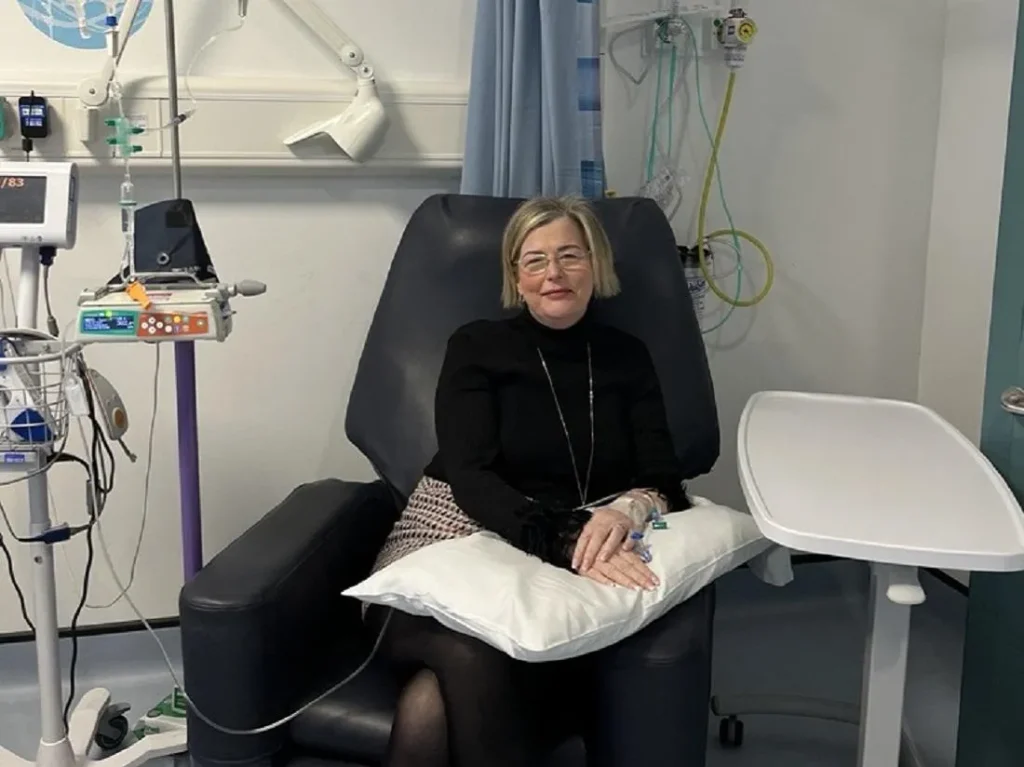
🗞️ BBC Midlands Today spoke to Becky Smith, who has received the new treatment as part of the clinical trial.
Becky (pictured above), 53 and from Solihull, was diagnosed with eye cancer in early 2020. Within weeks, she underwent surgery to remove her eye and adapted quickly to life with an artificial eye. For several years, she remained cancer-free – until the disease spread to her liver.
“I started immunotherapy last year, and while it offered hope, the side effects were brutal,” Rebecca explains. “I developed colitis, meningitis, and severe arthritis that attacked 90% of my joints. I couldn’t climb stairs, get dressed, or even get out of bed without help. It was devastating.”
These side effects forced Rebecca to take a year off work. “I love my job, but I simply couldn’t manage. Every cycle of treatment left me in hospital with side effects. It was a vicious circle.”
Standard steroid therapy offered little relief and clashed with her ongoing immunotherapy. That’s when her consultant suggested the REACT trial.
“I jumped at the chance. I thought, if it doesn’t work, at least I’ve tried – and maybe I’ll help others,” she says.
Rebecca was randomly assigned to receive adalimumab injections every two weeks. The impact was life-changing: “It’s been a godsend. My pain has eased, I can walk, I’ve returned to work, I can even wear heels again! My quality of life is back to what it was before.”
She still experiences mild aches before her next dose, but the improvement has been dramatic. “I’ve gone from being housebound to going on holiday and making memories with my family. Trials like this give people hope – and that’s priceless. Cancer and its side effects aren’t the end of the world. If you get the chance to join a trial, take it. It might change your life – it’s certainly changed mine.”
To compare the safety and effectiveness of these treatment strategies, the trial aims to recruit 70 ICI-induced arthritis patients across multiple centres in the UK. Participants will either receive current standard of care (initial steroid treatment in the form of prednisolone) or the anti-TNF drug adalimumab.
Treatments will be gradually reduced once the arthritis is controlled, or further treatment given if needed. The research team will compare the proportion of patients in each treatment group who have no arthritis and no steroid use 6 months after the start of treatment.
Researchers will also compare how fast the arthritis is controlled, and will continue to follow patients until one year to compare arthritis activity, quality of life, ability to function, total amount of immunosuppressive drugs received over time, number of ICI doses missed, new immune-related side effects, cancer outcomes and survival.
Researchers at BHP founder-members University Hospitals Birmingham (UHB) and the University of Birmingham, in collaboration with Kings College London (KCL), are leading a new study which aims to better understand the factors that influence how well older people recover from cancer treatment, as well as finding ways to keep the body strong.
While age is a known risk factor for developing cancer, in some people, treatments – including chemotherapy, immunotherapy, surgery, and radiation therapy – can trigger processes that resemble ageing.
The Resilience Breakthroughs in Older people Undergoing cancer proceDures (REBOUND) study is examining how key ‘hallmarks’ of ageing – the biological processes that naturally occur as we get older – are affected following treatment for bowel cancer in people aged 65 and over.
By understanding how the body responds to cancer treatment, researchers aim to develop new interventions that could prevent or reduce ageing-related changes and improve the number of years patients then spend in good health. The ultimate goal is to help older people with cancer remain active and continue doing the things that matter most to them.
Researchers will be analysing DNA for age-related changes; examining gut bacteria from stool samples; and assessing changes in blood and fat cells, with samples being collected at multiple timepoints before, during, and after surgery. These biological findings will be compared with tests of memory, thinking, strength, and muscle function, alongside information from medical records.
The study aims to recruit 172 participants aged 50 years and older who are scheduled to undergo bowel cancer surgery at UHB, Guy’s and St Thomas’ NHS Foundation Trust, or King’s College Hospital NHS Foundation Trust.
At UHB, recruitment is taking place across two of its hospitals: Queen Elizabeth Hospital Birmingham (QEHB) and Solihull Hospital. Study visits are undertaken flexibly in clinical environments, at the NIHR/Wellcome Trust Birmingham Clinical Research Facility, or within participants’ own homes, depending on works best for each individual.
The study opened to recruitment in Autumn 2024, and to date, 58 patients have been enrolled.
Ken Cox, 82 from Tamworth, who took part in the study last year, said: “I was diagnosed with bowel cancer in January 2025 and had surgery at Solihull Hospital in March. I heard about the study at the time of my diagnosis and wanted to take part as a way of giving something back.
“The team visited me at home to carry out the tests, which made things much easier. Everyone was absolutely wonderful and easy to talk to. I’d like to think this research will help others in the future, and I would encourage people to take up the opportunity if they can.”
Ken Cox, pictured taking part in the REBOUND study during a home visit
Professor Thomas Jackson, Consultant in Geriatric Medicine and General Internal Medicine at UHB and Professor in Geriatric Medicine at the University of Birmingham said: “This is really important work that couldn’t be done without the support of patients agreeing to be in the study. We want to understand how the biology of ageing changes when older people have significant events, such as major surgery, and why some people recover well, and others don’t. With this understanding, we can identify ways of improving recovery in everyone and maximising the benefits of cancer treatment.”
The project is a collaborative effort bringing together clinicians specialising in the care of older people, surgeons, and scientists with expertise in ageing and complex data analysis. It is supported by the Dynamic Resilience programme, funded by Wellcome Leap and the Temasek Trust.
The most detailed atlas of tumour cells from the deadliest form of pancreatic cancer has been developed by an international team of researchers, highlighting how tumour cells change their behaviour depending on their surroundings – and how this leads many promising treatments to fail in standard lab tests.
The research was a collaborative effort led by the BHP founders-members the University of Birmingham and University Hospitals Birmingham NHS Foundation Trust, working with pharmaceutical company Bristol Myers Squibb. Published in Cell Reports, their findings describe the most detailed spatial map to date of pancreatic ductal adenocarcinoma (PDAC).
In the study, tumour samples from 39 untreated pancreatic cancer patients were analysed using cutting-edge spatial transcriptomics technologies, allowing researchers to see which genes are active in cells and exactly where those cells are located in the tumour. This approach generated a massive dataset – comprising hundreds of thousands of spatial measurements and more than half a million individual cells – creating a comprehensive ‘atlas’ of pancreatic cancer tissue.
Pancreatic cancer remains one of the hardest cancers to treat, with few effective therapies and a five-year survival rate in the single digits. A major reason is the disease’s complexity: cancer cells are embedded in a dense, hostile tissue environment filled with scar-like material, low oxygen, and supportive cells that help tumours survive.
Dr Shivan Sivakumar, co-senior author from the University of Birmingham and consultant medical oncologist at University Hospitals Birmingham said: “This spatial atlas is expected to serve as a foundational resource for the research community, and may accelerate the development of treatments for a disease that has long resisted progress.
“By integrating spatial biology with functional genetic screening, we have created a roadmap for discovering therapies that target pancreatic cancer more effectively – especially combination treatments designed to disrupt both cancer cells and the environments that protect them.
“The findings suggest that environmental factors play a much greater role in tumour cell development in the pancreas, and identifies new intermediate tumour subtypes and highly proliferative cancer cells which together provide a more vivid picture of this deadly cancer.”
Dr. Konstantinos Mavrakis, Executive Director and Head of Discovery Biosciences Oncology at Bristol Myers Squibb and co-senior author of the publication emphasised the importance of scientific collaborations: “This study underscores how important it is to use real-world patient data to better understand the underlying causal human biology of a specific cancer type such as pancreatic cancer.”
Key findings:
Cancer cell identity depends on location. The study confirmed known pancreatic cancer subtypes, commonly called classical and basal-like, but showed that these identities are strongly shaped by the tumour’s local environment. In particular, aggressive basal-like cancer cells were consistently found in regions with low oxygen and dense fibrotic tissue.
A hidden cancer state comes into focus. Researchers discovered that an ‘intermediate’ tumour subtype is not just a mix of known states, but a distinct cancer cell identity. This finding clarifies long-standing confusion in pancreatic cancer classification.
Tumours contain a small but powerful growth engine. A previously underappreciated group of highly proliferative cancer cells was identified, marked by intense cell-division activity. Although relatively rare, these cells may disproportionately drive tumour growth.
Context hides critical vulnerabilities. The team used CRISPR gene-editing screens in cancer cells grown under realistic conditions such as low oxygen or inside living tumours. This revealed genetic weaknesses that are invisible in standard laboratory cultures, and may explain why many drug targets that look promising in the lab fail in patients.
Common lab models miss key disease features. Widely used mouse and cell-line models captured some aspects of human pancreatic cancer but often failed to reproduce the most aggressive tumour states and their surrounding environments. This highlights the need for better preclinical testing strategies.
Patients with Idiopathic Intracranial Hypertension (IIH), which causes headaches and potential sight loss, are being invited to take part in new research investigating the impact of weight loss drugs on their condition and eye health.
The IIH Advance trial, coordinated by clinical academics at BHP founder-member the University of Birmingham, aims to recruit 86 people with IIH from around the UK to take part in the trial lasting over a year, which will be delivered in partnership with Specsavers.
IIH is currently considered a rare disease with, affecting approximately 5,000 patients in the UK. It predominantly affects women of childbearing age, and 90% of those living with it also experience obesity. Previous studies at the University have established a direct link between IIH, metabolic dysregulation and obesity, so researchers anticipate that IIH prevalence is set to increase significantly as obesity levels continue to rise.
During the trial, participants will receive the weight loss drug Tirzepatide (commonly known as Mounjaro) and will have Optical Coherence Tomography (OCT) eye scans at a participating branches of Specsavers to monitor swelling of the optic nerves, called papilloedema, which is caused by intracranial pressure.
Dr Maria Lange from the University of Birmingham and co-investigator on the trial said: “IIH is a debilitating condition, and after years of research to better understand the condition, this innovative trial will see whether weight loss, achieved by using the drug Mounjaro could have a significant positive impact for patients.”
“As GLP-1 medicines such as Mounjaro have become available for weight management through the NHS, we hope that the IIH Advance trial will establish a link between losing weight using these drugs and reducing the symptoms of IIH.”
Welcoming the trial, Specsavers’ director of professional advancement Paul Morris said: “IIH is a serious condition that can lead to blindness, and the role that community optometrists and their skilled teams can play in harnessing technology to detect serious eye conditions is pivotal. That’s why regular sight tests are so important. We welcome this innovative trial and are looking forward to collaborating with participants in it as well as the team at the University of Birmingham.”
People with a diagnosis of IIH who have papilloedema and live in the UK will be eligible to take part and are invited to self-nominate themselves to the trial. No doctor’s referral is required, and patients will not need to visit hospital or the trial centre in Birmingham.
Each participant will receive regular deliveries of Mounjaro to their home and will have regular calls with a research team member. They will also undergo eye scans at a participating Specsavers practice at the start of the trial, at six and 12 months, and at the conclusion of the trial.
Dr Jessie Gew, from the University of Birmingham and co-investigator adds: “IIH patients can now directly contact the trial team to self-refer. Once contact is made, our team will work closely with each participant to review relevant medical documentation and confirm eligibility for the study.”
Professor Alex Sinclair, Consultant Neurologist and Professor of Neurology at University of Birmingham, who leads the Idiopathic Intracranial Hypertension Clinical Service at University Hospitals Birmingham NHS Foundation Trust, said : “This trial is an example of the type of pioneering research that could ease pressure on the NHS through innovative community-focused collaboration with industry. We believe that this vision for a trial that streamlines care and empowers patients to participate and receive treatment from the comfort of their own homes is exactly the type of research that the NHS 10-year plan is calling for.”